The path from here to $25-50M ARR.
Year 1 turns pilots into paying customers. Year 2 sells more workflows into the same logos. Year 3 multiplies reach through channel.
Design-Partner Conversion
Multi-Workflow Expansion
Multi-Discipline at Scale
Why the architecture matters.
Structural cost moat. Validated outputs. Self-healing pipelines.
85% of queries resolve at the bottom two tiers. The LLM is the exception, not the rule.
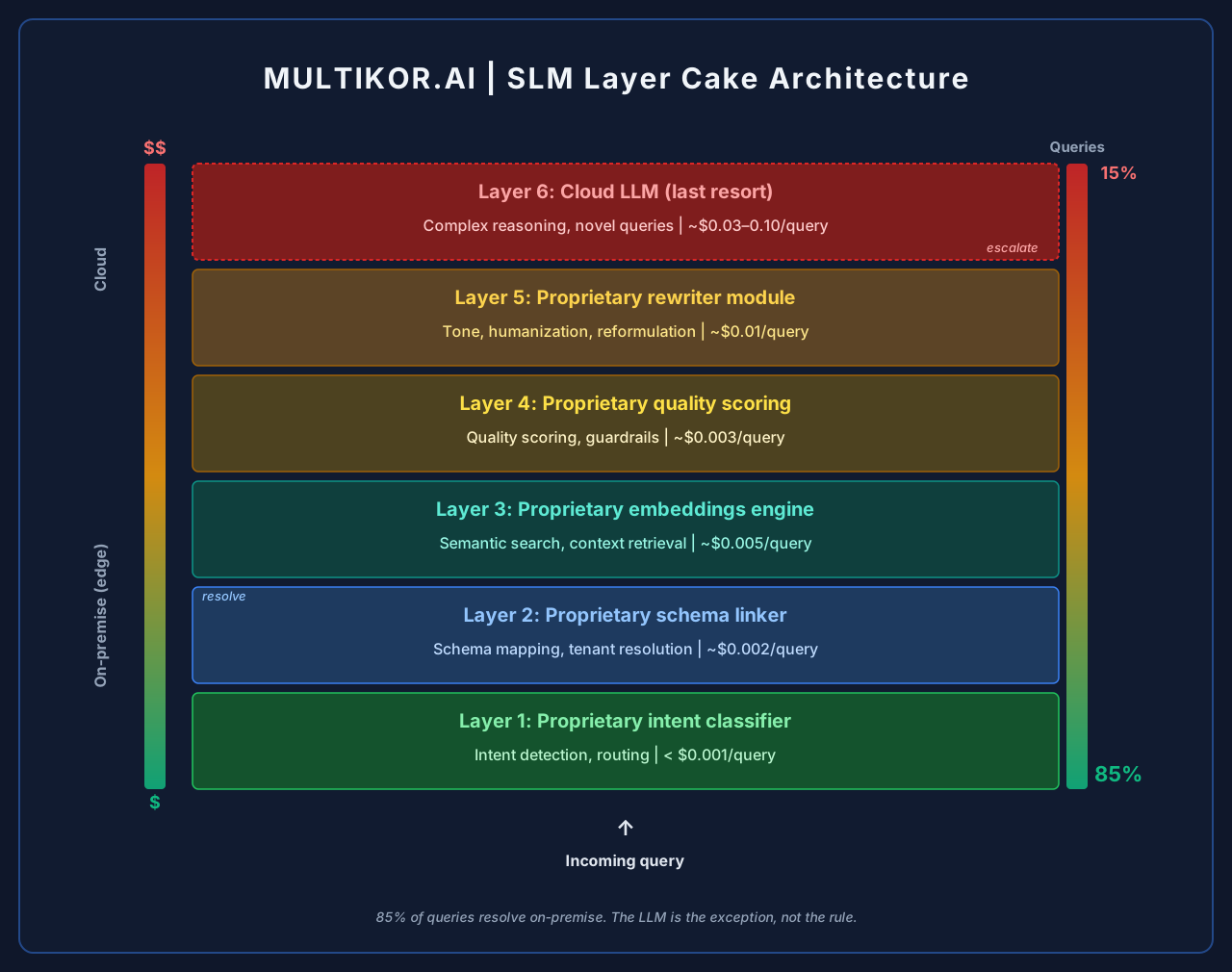
SLM-first, not LLM-first
85% of queries resolve on small language models running on owned edge hardware. Only the hardest ~15% escalate, cheapest tier first.
Per-query SLM cost runs under $0.003 on owned edge nodes. Cloud LLM equivalents (Bedrock Sonnet/Opus, GPT-4 class) average $0.04–$0.05.
Weighted unit cost at 85% SLM disposition ≈ $0.005, vs ~$0.05 LLM-first. Total AI infra under $500 per customer per year.
The full 6-tier stack runs on a single 128GB unified-memory edge box (deck Slide 7), single-digit ms latency on most operations.
Self-optimizing, not consultant-dependent
24 autonomous feedback loops across 7 categories. The platform gets smarter on the customer's own data without an in-house ML team.
24 loops × 7 categories: OFL (Output), DQL (Data Quality), LFL (Latency), GFL (Gate), UFL (User), PFL (Performance), CFL (Cost). Per-tenant LoRA flywheel runs continuously.
Qwen2.5-1.5B schema linker hits 94% action accuracy on internal benchmarks. End-to-end integration test pass rate 96.7% (MKOR-SLM-013/014).
Self-healing, not ticket-driven
Pipelines detect regressions, roll back, and write remediation back to the feedback row. Workflows survive production.
142 of 160 prompt versions in production were generated by the self-healing regression-remediation loop.
Production trace 2026-05-08: feedback row fb-de148e17d270 triggered rag_pipeline_main v143 canary inside the same shift. No human file-ticket cycle.
The Multikor Quality Gate
Schema drift is the silent killer of enterprise AI. Every output is scored against deterministic confidence thresholds and validated against the live schema graph of the customer's data, not prompt guardrails. Mathematical formalism protected as a trade secret pending patent application.
Confidence + relevance
Confidence thresholds flag when new data falls outside learned distribution. Vector relevance checks validate retrieval quality. Degradation triggers automatic recalibration.
Structural coherence + auto-remediation
Outputs cross-referenced against the live schema graph. When drift is detected: quarantine, recalibrate, recompute — autonomously. ~95% PASS, ~5% HITL on Apexon production trace.
Precision routing inside the gate: quantitative questions go to the schema linker for exact answers ("How many open claims over $50K?"). Qualitative questions go to vector search with relevance validation ("Which claims resemble the Patterson case?").
Two pipes inside one gate. Competitors force both through the same path.
Competitive Landscape
Eight real 2026 competitors mapped by satisfaction and market presence. Multikor's trajectory is plotted from today (Seed) through Series A target to Series B horizon.
Why these eight, and why Multikor wins from this quadrant
DIFFERENT TERRITORY
Leaders we don't head-on.
They sell expansion to their own customers. We sell first-AI to ours.
Salesforce Agentforce, Microsoft Copilot Studio, Glean — formidable inside their existing customer base.
Why not head-on: different buyer (existing-platform expansion budget), different price floor, different problem (own data estate, not multi-system SMB).
SAME WEDGE
Missing capabilities.
No schema validation. No on-prem. No multi-discipline at launch.
StackAI, Sierra, Lindy AI — same SMB+mid-market band, same workflow-automation framing.
What they lack: validation against the customer's live schema, on-prem option, multi-discipline span at launch.
FOUNDATION MODELS
Wrong unit economics.
$0.04–$0.05/query can't underwrite $150–$400/agent/mo.
OpenAI, Google Gemini sell intelligence by the token, not workflows by the discipline.
Why we can: their per-query cost ($0.04–$0.05) can't underwrite $150–$400/agent/mo SMB pricing without cannibalizing their own API revenue.
THE MULTIKOR WEDGE
Five-axis combination.
No rival matches on a single axis. None come close on all five.
The five axes: SLM-first at <$0.003/query, Quality Gate validating against the customer's live schema, multi-discipline at launch, on-prem option for regulated buyers, channel-led scale via Apexon-class partners.
Competitors match one axis at best. The combination is what they can't replicate without a multi-year platform rebuild.
Trust and enterprise readiness.
Regulated buyers need compliance from day one, not eventually.
Security & compliance
Tenant isolation, PII redaction before inference, immutable audit logs, role-based access control. Architected for SOC 2 Type II and HIPAA from day one.
In flight (deck Slide 11): HIPAA and SOC 2.
Roadmap (deck Slide 11): FCA, PCI-DSS, ISO 42001, NIST AI RMF, EU AI Act. Deepens as Trustwise integration matures.
The on-prem License + Annual Support path extends these controls to regulated workflows that pure-SaaS competitors can't serve.
Cloud, on-prem, or hybrid
AWS-native cloud reference. NVIDIA GB10 on-prem reference (Bifrost). Hybrid: control plane in customer cloud, compute on-prem. Quality Gate governs outputs either way.
License + Annual Support Contract: 3-year minimum, ~30% ARR uplift per enterprise customer versus the SaaS-only baseline.
Unlocks regulated buyers (healthcare, financial services, insurance, government) that pure-SaaS competitors can't serve.
Key risks and mitigations
Big Tech ships competing tooling
They don't have customer-specific operational data. Per-tenant LoRA on owned hardware compounds inside each customer; the Quality Gate + data flywheel take years to rebuild.
Design partner doesn't convert
Apexon design-partner is live and validating the channel-led model. Multi-vertical design-partner cohort (healthcare, veterinary, claims, financial services back-office) reduces single-logo dependence.
LLM costs collapse
This helps us. The ~15% escalation cost gets cheaper. Our moat — validation, data sovereignty, domain-trained models — isn't LLM-priced.